PROMOTED by


On October 28, Taiwanese leader Lai Ching-te (賴清德) made headlines when he publicly referred to Israel as a “valuable model” for Taiwan’s defence.[1] He delivered the remark during a dinner in Taiwan organised by the American Israel Public Affairs Committee (AIPAC), a Washington-based pro-Israel lobby. Reiterating his earlier proposal for the construction of an air-defense network for Taiwan – a “T-Dome” – modelled on Israel’s Iron Dome,[2] Lai urged for closer bilateral security cooperation, invoking biblical history:
“Israel’s determination and ability to defend its territory is a valuable model for Taiwan. I have always believed that Taiwan should adopt the spirit of David versus Goliath in standing up to authoritarian coercion.”[3]
Israeli experts largely welcomed Lai’s statement, viewing it as a further expression of goodwill, solidarity and support from Taipei, which – since the outset of the Gaza War on October 7, 2023 – has rhetorically and materially supported Israeli society and economy. Tel Aviv’s warming ties with Taipei unfold amid a perceived chill in Sino–Israeli relations, due in large part to Beijing’s pro-Palestine rhetoric.[4]
This ChinaMed Observer examines the Israeli debate surrounding Tel Aviv’s relations with Taipei, which has drawn heightened scrutiny following recent reports on strategic cooperation circumventing Beijing.
Although the Israel–Taiwan relationship has a long, contentious, and oft overlooked history,[5] Israeli observers interpreted Lai Ching-te’s announcement of the proposed “T-Dome” as the culmination of more recent trends, namely, Taipei’s visible, consistent and increasingly proactive diplomatic outreach over the two years of war in Gaza. From the beginning of the conflict, Taipei strongly condemned Hamas’ “terrorist attack on Israeli civilians” and expressed its determination to continue supporting Tel Aviv:
“[We] will continue to cooperate with like-minded countries to jointly resist all forms of terrorist attacks.”[6]
Taipei’s rhetorical solidarity was followed by immediate material assistance, notably a USD 70,000 donation to the IDF and Israeli families from the Taipei Economic and Cultural Office in Israel, led by Representative Ya-Ping Abby Lee (李雅萍).[7] Similarly, during the Israel–Iran War in June 2025, the Taiwanese mission delivered generous donations to Israeli charities supporting Bat Yam residents whose homes were damaged by Iranian missile attacks, accompanied by Lee’s message: “you are not alone.”[8]
Taiwan’s engagement extended beyond donations. Its outreach adopted a strategic approach aimed at cultivating ties with the Israeli public through civil society diplomacy, including university exchanges, liaising with NGOs, and reaching out to members of the Knesset, the Israeli parliament.[9] For instance, in contrast to China’s University of International Business and Economics’ decision to permanently close its campus in Israel in September 2024,[10] the Taipei Office in Tel Aviv has actively engaged with Israeli youth at Reichman University, the Hebrew University, and even with Druze communities.[11]
Lee’s pro-Israel activism stood in stark contrast to Beijing’s limited presence and declining popularity among both Israeli officials and the wider public. Tuvia Gering, a researcher at the Israel–China Policy Center at the Institute for National Security Studies (INSS), described Lee as having been “extremely active at using this window of opportunity where the fissure between Israel and China is at its widest and mutual trust at its lowest point […] while the Chinese were nowhere to be seen.”[12]
In 2025 alone, Taiwan invited and paid for the visits of multiple unofficial Knesset delegations,[13] as part of its diplomatic effort to strengthen ties with Tel Aviv. The most recent delegation was headed by Member of Knesset Boaz Toporovsky in his capacity as chairman of the Israel–Taiwan Parliamentary Friendship Association. On September 17, the delegation met with Lai Ching-te and presented a statement signed by 72 Israeli legislators affirming their support for Taiwan’s participation in international forums.[14]
Following these visits, several Members of the Knesset reportedly started referring to Taiwan as a “country,” drawing criticism from China’s Ambassador to Israel Xiao Junzheng. Xiao not only publicly condemned Taiwan’s initiative, but also singled out Toporovsky for “interfering in China’s internal affairs” by addressing Lai as “president” and claiming to speak “on behalf of the Israeli people.”[15] Even though Knesset members are not government officials, this kind of behaviour “violated Israel’s own commitment to the One-China principle” according to Xiao.[16] Israel’s official response dismissed the criticism, stating that “parliamentary delegations are unofficial and do not represent the Knesset.”[17]
Taiwan’s parliamentary diplomacy also attracted attention from Chinese experts. Xin Qiang, director of the Taiwan Studies Center at Fudan University, described the exchange as “political theater,” while Ding Long, Vice Director of the Middle East Studies Institute at Shanghai International Studies University, labelled it as a “provocative” vehicle for Israeli politicians interested in finding a diplomatic “breakthrough” amid Israel’s international isolation.[18]
Taiwan’s proactive outreach, coupled with the support shown by Israeli lawmakers, has invigorated the enthusiasm for deepening practical cooperation across trade and technology sectors among Israelis, who have come to perceive Taipei as an actor sharing similar “values of freedom, equality, human rights, and the rule of law, all in a challenging geopolitical environment.”[19]
During the 15th Taiwan–Israel Economic and Technological Cooperation Conference, held online on November 17, 2025, both sides pledged to continue expanding trade and industry partnerships.[20] In an interview with Israeli online newspaper Walla, Abby Lee underscored the complementarities between the Israeli and Taiwanese economies, describing the two as “irreplaceable international partners” in the technology sector:
“We enjoy the status of major players in the world of technology. Taiwan is a leader in the field of hardware and Israel is one of the world leaders in the field of software.”[21]
Israeli experts echoed this assessment, recognizing the synergy between Israel’s start-up innovation ecosystem and Taiwan’s scale-up economy. They perceive access to, and support from, a friendly and capable partner as increasingly crucial amid shifting global trade dynamics. Ynet tech reporter Raphael Kahan suggested that “Taiwan is approaching Israel in an attempt to establish a technological alliance” in the face of a perceived “growing threat from China,” potentially by integrating Israeli industries into TSMC’s partnerships with the United States in a trilateral technological alliance.[22]
Dean Shmuel Elmas, Chief Geopolitics Analyst at Globes, highlighted the strategic importance of Taiwan’s industrial capacity (something Israel lacks) in the scenario of supply chain disruptions if not arm embargos amid the global trade war and Israel’s deepening diplomatic isolation.[23] This assessment also reflects growing anxiety in Israel over its international standing in the aftermath of the Gaza War, which prompted Israeli Prime Minister Netanyahu to call for the country to “adapt to an economy with autarkic characteristics.”[24]
Taipei’s unequivocal support for Tel Aviv has not gone unnoticed in the global reckoning with the war in Gaza and its humanitarian consequences. It has likewise drawn attention – albeit limited – within Taiwan itself. Taiwanese-American journalist Brian Hioe (丘琦欣), writing for the radical magazine New Bloom, explains Lai Ching-te’s outreach to Tel Aviv as an attempt to play “the Israel card” in order to appeal to U.S. conservatives and MAGA Republicans, whose support for Taiwan has appeared increasingly uncertain.[25]
The Israel–Taiwan rapprochement has also raised concerns about secret agreements. Among these were allegations – denied by the Taiwanese pager company Gold Apollo – of involvement in the boobytrapping and detonation of the thousands of pagers destined for Hezbollah, which killed 32 people and wounded thousands more in Lebanon, including children and civilians, between September 17 and 18, 2024. In this context, Amnesty International Taiwan urged the government to strengthen oversight to prevent Taiwanese products from being diverted for Israeli military use.[26]
Another controversy was sparked after reports that Abby Lee had pledged to donate approximately half a million USD dollars to the Nanasi Medical Centre in Sha’ar Binyamin, an illegal Israeli settlement in the Occupied Palestinian Territories.[27] Facing internal and international criticism, the Taiwanese Ministry of Foreign Affairs clarified that the donation had not been finalized but was “currently under review.”[28] Chiu E-Ling, head of Amnesty International Taiwan, warned that the reported involvement could make Taipei complicit in Israel’s settler movement, which violates international law.[29]
Human rights activists within Taiwan have increasingly contested the government’s Israel policy, linking it to what Amnesty International Taiwan also defined as a plausible “genocide” in Gaza,[30] in line with the ruling of the International Court of Justice. In its defence, Taipei has attempted to deflect the criticism by characterizing itself as a “peace-loving actor” that, despite lacking official ties with either party of the conflict, has provided aid to both Israelis and Palestinians, including a one-off donation of USD 500,000 to Mercy Corps U.S. in May 2024 and a recent USD 500,000 pledge to International Medical Corps, another US-based organization, for humanitarian relief efforts.[31] While Taipei operates a representative mission in Tel Aviv, its engagement with Palestine is mediated through the Economic and Cultural Office based in Jordan (Taiwan has no plans to recognize a Palestinian state, with which Beijing has formal diplomatic ties since 1988).[32]
Kerim Friedman, a Jewish anthropologist and a Professor in the Department of Ethnic Relations and Cultures at National Dong Hwa University in Taiwan, described Taipei’s Israel policy as an instance of schismogenesis, a process whereby “groups seek to differentiate themselves from rivals by taking up contrary […] political alignments.”[33]
“I think something like this has hurt support for Palestinians in Taiwan. If the Chinese are for it, the logic goes, then Taiwan must be against it.”[34]
This dynamic appears to operate in reverse as well, shaping Israeli perceptions toward Beijing and Taipei. Demonstrations of Palestine solidarity in Taiwan went mostly unreported in Israeli media. Instead, Israeli commentators underscored Taipei’s diplomatic goodwill in contrast to Beijing’s pro-Palestine rhetoric and its ties with states considered hostile to Israel, such as Iran. Galia Lavi, Director of the Israel-China Center at the INSS, argued that even though Knesset members’ sympathies for Taiwan are unofficial, they nevertheless “reflect Israeli public opinion, which has been influenced by China’s response to October 7.”[35]
“In such an atmosphere, it is difficult to accuse MKs of promoting ties with Taiwan, whose support for Israel has been consistent and open since the beginning of the fighting.”[36]
While not all Taiwanese are fully comfortable with deepening ties with Israel, Israeli sources perceive the emotional dimension of the relationship as reciprocal, rooted in shared democratic values and a similar security environment. For instance, the Israeli press has given considerable attention to parallels drawn by Taipei officials, discussing how just as Israel is surrounded by nations hostile to it, Taiwan’s own situation is marked by “challenges to [its] international status and threats to [its] sovereignty.”[37] They shared how Lai Ching-te contended that the idea of “peace through strength” – a term used by U.S. President Donald Trump – is a principle shared by Israeli, American and Taiwanese societies.[38]
Ofir Dayan, an associate researcher at INSS’ Israel-China Policy Center, observed that only a few days after October 7, Taiwan’s Ministry of Defense had sent a civil delegation to study Israel’s response to the war, visiting communities and touring emergency operation centers.[39] In the process, Taipei formalized partnerships with Israeli rescue, emergency, and civil aid organizations to promote exchanges in emergency response.[40] Beyond technical learning, these gestures underscore how deeply Taipei interprets Israel’s wartime experience as a mirror to its own existential concerns, which culminated in Lai’s above-mentioned announcement to construct a “T-Dome” for island defence. According to the Israeli Daily Maariv, former Taiwanese Deputy Defense Minister Fu Hong-hui (柏鴻輝) visited Israel in September 2025 to promote the project and discuss the transfer of advanced military technology, in complete secrecy and far away from the eyes of the media and the public.[41]
Interestingly, according to Israeli media, just as Taipei is seeking to learn from the wars in the Middle East and Israeli societal resilience, Beijing has likewise drawn its own lessons. They contend that China viewed the June 2025 war against Iran as a test case, closely monitoring U.S. capabilities and, more importantly, the extent of Washington’s willingness to intervene on behalf of an ally, Israel.[42]
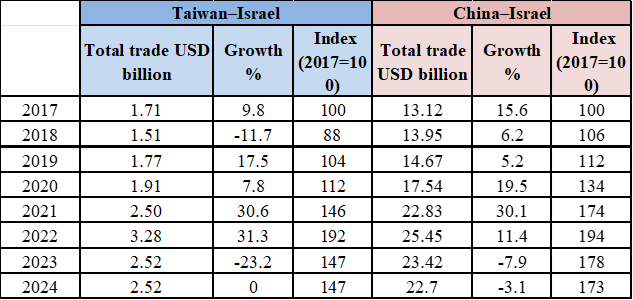
Israeli experts have debated the rapprochement between Tel Aviv and Taipei in the context of Israel’s China policy. Israel has largely welcomed and responded positively to Taiwan’s outreach. Yet, while agreeing on the emotional dimension of the “shift” – motivated by shared values and geopolitical similitarities – they caution that careful balancing is required to maintain relations with Beijing. After all, Galia Lavi explained that despite the low media profile, Chinese trade with Israel did not stop during the war in Gaza (as shown in the graph below), and Chinese workers remained in the country even “under the threat of missiles.”[43]

Listing these examples as evidence of China’s practical support, Lavi stressed that given Beijing’s strategic importance, Tel Aviv does not intend to change its commitment to the One China policy. Notwithstanding, “elected officials are required to exercise discretion” in managing relations with China, given Beijing’s stance on the Palestinian issue, which many in Israel view as hostile in the international arena.[44]
Compared to China’s pro-Palestine stance, Taiwan differentiated itself with open support for Israel since the beginning of the Gaza War. Constant engagement and diplomatic outreach created positive momentum for strengthening relations – despite domestic and international criticism directed at Taipei for supporting Tel Aviv. Israeli commentators warmly welcomed solidarity coming from a “like-minded” actor with shared values and facing similar “security challenges.” While both sides recognize clear economic incentives for deepening cooperation, Israeli experts emphasized a scenario in which Taiwan’s manufacturing capacity could mitigate Israel’s vulnerability to supply-chain pressure if defence-related export controls tighten.
While Israel may not change its One-China policy anytime soon, Taipei’s strategic civil-society diplomacy has generated measurable sympathy amid Israeli public opinion, particularly against the backdrop of China’s perceived hostility. In this context, and amid growing expert calls for a reassessment of Israel’s China policy,[45] the future of Sino-Israeli relations remains uncertain.
At the end of the day, Israel is recovering from war and preoccupied with managing its domestic political fallout while the international community is focusing on the implementation of Trump’s Gaza Peace plan. Neither Beijing nor Taipei are a priority, but both Israelis and Palestinians will remember how each responded to the war.
Amanda CHEN is a Research Fellow at the ChinaMed Project. She is a graduate of SOAS University of London, Sciences Po Paris, and Peking University. Her research interests include China–Middle East relations, conflict mediation practices, and global philanthropy, with a focus on the role of civil society in these processes.
[1] The Jerusalem Post, “Taiwan unveils ‘’T-Dome’ missile shield modeled on Israel’s Iron Dome,” November 26, 2025, https://www.jpost.com/defense-and-tech/article-876274.
[2] The T-Dome project was announced during Lai’s National Day address on October 10, 2025. See Joseph Yeh, “Lai pledges to build ‘T-Dome’ air defense system in national address,” Focus Taiwan, October 10, 2025, https://focustaiwan.tw/politics/202510100006.
[3] Yuval Peso, “Nasi Taiwan: ‘Israel Hi Model LeHaganat Yi’” נשיא טייוואן: ״ישראל היא מודל להגנת אי״ [Taiwan President: “Israel is a model for island defense”], Globes, October 28, 2025, https://www.globes.co.il/news/article.aspx?did=1001524797.
[4] Itamar Eichner, “Paragon LeTaiwan, Akitza LeSin: Kakh Hishpia HaMilkhama Al Yakhasei Israel Mul Shtei HaYerivot” פרגון לטייוואן, עקיצה לסין: כך השפיעה המלחמה על יחסי ישראל מול שתי היריבות [A paragon for Taiwan, a sting for China: This is how the war affected Israel’s relations with the two rivals], Ynet, October 11, 2024, https://www.ynet.co.il/news/article/r1yb0vlkkg.
[5] See Nathan Greppi, “Israel and Taiwan: A common history of survival,” Ynet, May 9, 2025, https://www.ynetnews.com/article/bjyshrun0. Also see Evan Stubbs, “Students of Survival: Israel and Taiwan as Partners in Geopolitical Exile,” Yale Journal of International Affairs, May 23, 2024, https://www.yalejournal.org/publications/students-of-survival.
[6] Ministry of Foreign Affairs, Taiwan, “MOFA condemns terrorist attacks on Israeli civilians by Palestinian military group Hamas,” October 7, 2023, https://en.mofa.gov.tw/News_Content.aspx?n=1328&sms=273&s=115635.
[7] Caroline Haïat, “Taiwan Embassy donates $70,000 to Israeli soldiers and families,” i24News, October 23, 2023, https://www.i24news.tv/en/news/israel-at-war/1698071583-taiwan-embassy-donates-70-000-for-israeli-soldiers-and-families.
[8] Itamar Eichmer, “Taiwan Tarma 1,2 Milion Shekel LeNifgayim Bat Yam VeLeZaka, Beit Kholim MeLos Angeles He’evir 100 Elef Dolar LeSoroka” טייוואן תרמה 1.2 מיליון שקל לנפגעי בת ים ולזק”א, בית חולים מלוס אנג’לס העביר 100 אלף דולר לסורוקה [Taiwan donated 1.2 million shekels to the Bat Yam victims and to ZAKA, a Los Angeles hospital transferred $100,000 to Soroka], Ynet, June 25, 2025, https://www.ynet.co.il/activism/article/sy80nvoele.
[9] Ofir Dayan, “Friendship in Times of Trouble: Israel–Taiwan Relations During the Swords of Iron War,” INSS Insight No. 2019, July 24, 2025, https://www.inss.org.il/publication/israel-taiwan-2025/.
[10] Navit Sommer, “HaUniversita HaSinit HaRishona BeIsrael – Ozevet Et HaAretz” האוניברסיטה הסינית הראשונה בישראל - עוזבת את הארץ [The first Chinese university in Israel - leaving the country], Ynet, September 18, 2024, https://www.ynet.co.il/economy/article/rjp7thp6c.
[11] See note 9, Ofir Dayan, July 24, 2025, https://www.inss.org.il/publication/israel-taiwan-2025/.
[12] James Baron, “Navigating Taiwan’s Complex Relationship with Israel,” Global Taiwan Institute, January 8, 2025, https://globaltaiwan.org/2025/01/navigating-taiwans-complex-relationship-with-israel/.
[13] Knesset delegations arrived in Taiwan in February, May, July and September. Taipei’s sponsorship of the visits was made evident in a Haaretz inquiry by Nir Gontarz, “Lama Kol Kach Harbe Khavrei Knesset Nosyim LeTaiwan, Veod BeZman HaMilkhama? ‘Lehakir Et HaMurkavut Shel HaMedina’” למה כל כך הרבה ח״כים נוסעים לטייוואן, ועוד בזמן מלחמה? ״להכיר את המורכבות של המדינה״ [Why do so many MKs travel to Taiwan, especially during a time of war? “To learn about the complexity of the country”], Haaretz, September 4, 2025, https://www.haaretz.co.il/magazine/on-the-line/2025-09-04/ty-article/.highlight/00000199-0f65-dd6c-afdb-6fe742c00000.
[14] Itamar Eichmer, “China issues threat to Israeli lawmaker over Taiwan visit: ‘Will fall and shatter into pieces,’” Ynet Global, September 22, 2025, https://www.ynetnews.com/article/hk6eshcsee.
[15] Ibid.
[16] Ibid.
[17] Galia Lavi, “Hayim Israel Noteshet Et Mediniyut Sin Akhat?” ?האם ישראל נוטשת את מדיניות ״סין אחת״ [Is Israel abandoning the ‘One China’ policy?], Calcalist, August 11, 2025, https://www.calcalist.co.il/local_news/article/rjaremdoeg.
[18] Global Times, “Israeli lawmaker’s Taiwan visit political stunt, won’t shake one-China principle,” September 22, 2025, https://www.globaltimes.cn/page/202›509/1344199.shtml.
[19] AP and TOI Staff, “Taiwan’s foreign minister: Closer ties with Israel align with the island’s interest,” The Times of Israel, November 12, 2025, https://www.timesofisrael.com/taiwans-foreign-minister-closer-ties-with-israel-align-with-the-islands-interests/.
[20] Taiwan Today, “Taiwan, Israel stage economic, technological conference,” November 19, 2025, https://www.taiwantoday.tw/Economics/Top-News/277917/Taiwan%252C-Israel-stage-economic%252C-technological-conference.
[21] Yoav Shuster, “Khadshanut, Demokratia VehaKhayim BeTzilo Shel Iyum Kiyumi: Sipur HaYedidut HaMufla’a Ben Israel LeTaiwan” חדשנות, דמוקרטיה והחיים בצילו של איום קיומי: סיפור הידידות המופלאה בין ישראל לטייוואן [Innovation, Democracy, and Living in the Shadow of an Existential Threat: The Story of the Wonderful Friendship Between Israel and Taiwan], Walla, September 17, 2025, https://news.walla.co.il/item/3732568.
[22] Raphael Kahan, “Taiwan Mekhazeret Akharei Israel VeArtzot Habrit VeZo Hizdamnut SheAlula Leatzben Et Sin” טאיוואן מחזרת אחרי ישראל וארה״ב וזו הזדמנות שעלולה לעצבן את סין [Taiwan is following Israel and the US, and this is an opportunity that could irritate China], Ynet, March 7, 2025, https://www.ynet.co.il/digital/technews/article/bysq11n00o1e.
[23] Dean Shmuel Elmas, “BeZman SheBeEuropa Medabrim Al Embargo, BaTa’asiyot HaBitkhoniyot Khosheshim MeTarkhish Khamur Yoter” בזמן שבאירופה מדברים על אמברגו, בתעשיות הביטחוניות חוששים מתרחיש חמור יותר [While Europe is talking about an embargo, the defense industries fear a more serious scenario], Globes, September 16, 2025, https://www.globes.co.il/news/article.aspx?did=1001521952.
[24] Yuval Einhorn, “Netanyahu Kara Lehistage LeAutarkia. Ma Ze Omer?” נתניהו קרא להסתגל לאוטרקיה. מה זה אומר [Netanyahu called for adapting to autarky. What does that mean?], Globes, September 16, 2025, https://www.globes.co.il/news/article.aspx?did=1001521730.
[25] Brian Hioe, “Lai Tries to Play Israel Card to Appeal to MAGA Republicans,” New Bloom, November 1, 2025, https://newbloommag.net/2025/11/01/lai-israel-maga/.
[26] See note 12, James Baron, January 8, 2025, https://globaltaiwan.org/2025/01/navigating-taiwans-complex-relationship-with-israel/.
[27] E-Ling Chiu, “Why Is Taiwan Supporting an Illegal Israeli Settlement in the Occupied West Bank?,” The Diplomat, July 26, 2025, https://thediplomat.com/2025/07/why-is-taiwan-supporting-an-illegal-israeli-settlement-in-the-occupied-west-bank/.
[28] Ibid.
[29] Ibid.
[30] Amnesty International Taiwan, “Táiwān wù chéngwéi bālèsītǎn zhǒngzú mièjué bāngxiōng, qiǎnzé wàijiāo bù juānzhù yǐ guó túnkěn qū jì huà” 台灣勿成為巴勒斯坦種族滅絕幫凶,譴責外交部捐助以國屯墾區計畫 [Taiwan should not become an accomplice to Palestinian genocide; condemnation of the Ministry of Foreign Affairs’ donation to Israel’s settlement project], August 6, 2025, https://www.amnesty.tw/node/22877.
[31] Kelvin Chen, “Taiwan donates NT$15.5 million to support medical aid in Palestine,” Taiwan News, November 5, 2025, https://www.taiwannews.com.tw/news/6236539.
[32] Joseph Yeh, “Taiwan has no immediate plan to recognize a Palestinian state: MOFA,” Focus Taiwan, September 22, 2025, https://focustaiwan.tw/politics/202509220017.
[33] Kerim Friedman, “Yes ‘Taiwan Can Help,’ but not if it continues to ignore Palestinian voices,” Positions Politics, July 29, 2025, https://positionspolitics.org/p-kerim-friedman-yes-taiwan-can-help-but-not-if-it-continues-to-ignore-palestinian-voices/.
[34] Ibid.
[35] See note 17, Galia Lavi, August 11, 2025, https://www.calcalist.co.il/local_news/article/rjaremdoeg.
[36] Ibid.
[37] Guy Ulster, “Nasi Taiwan Hitzdia LaAm HaYehudi: ‘Nekhushim Lehagen Al Shitkhenu Kmo Israel’” נשיא טייוואן הצדיע לעם היהודי: ״נחושים להגן על שטחנו כמו ישראל״ [Taiwan’s president salutes Jewish people: “We are determined to defend our territory like Israel”], Walla, October 28, 2025, https://news.walla.co.il/item/3790265.
[38] Ibid.
[39] See note 9, Ofir Dayan, July 24, 2025, https://www.inss.org.il/publication/israel-taiwan-2025/.
[40] Ibid.
[41] Maariv, “Sin BeHelem: Israel Mefatachat LaOyevet HaGedola Kipat Barzel | Divuach” סין בהלם: ישראל מפתחת לאויבת הגדולה כיפת ברזל | דיווח [China in shock: Israel develops Iron Dome for its greatest enemy | Report], October 22, 2025, https://www.maariv.co.il/news/politics/article-1244016.
[42] Roni Yacobi, “Ma Meshutaf LeIsrael, Iran VeTaiwan? Yoter Mima SheNidme” מה משותף לישראל, איראן וטייוואן? יותר ממה שנדמה [What do Israel, Iran, and Taiwan have in common? More than you think], Walla, June 23, 2025, https://news.walla.co.il/item/3759815;
Adir Ben Ami, “Eikh Mashpi’a HaTkifa HaAmerikanit BeIran Al Taiwan?” איך משפיעה התקיפה האמריקאית באיראן על טיוואן [How does the American attack on Iran affect Taiwan?], Bizportal, June 26, 2025, https://www.bizportal.co.il/globalmarkets/news/article/20018677;
Yishai Halper, “Sin Hishkifa AlMilkhemet Iran MeHaTzad, VeNitzla Et HaHizdamnut Lilmod” סין השקיפה על מלחמת איראן מהצד, וניצלה את ההזדמנות ללמוד [China watched the Iran war from the sidelines, and took the opportunity to learn], Haaretz, June 26, 2025, https://www.haaretz.co.il/ty-WRITER/0000017f-da36-d938-a17f-fe3ed1890000.
[43] See note 17, Galia Lavi, August 11, 2025, https://www.calcalist.co.il/local_news/article/rjaremdoeg.
[44] Ibid.
[45] Eyal Propper, “The future of Israel – China Relations,” The Times of Israel, December 3, 2025, https://blogs.timesofisrael.com/the-future-of-israel-china-relations/.