PROMOTED by


Disclaimer: The terminology and analysis presented here does not necessarily reflect the personal views of the author or official stance of the ChinaMed Project, T.wai. For the sake of consistency and clarity, this piece employs the commonly recognized term “Western Sahara.”
On October 31, 2025, China abstained from the United Nations Security Council vote on Resolution 2797, which endorses Morocco’s 2007 Autonomy Proposal for the Western Sahara as a framework to resolve the long-standing conflict between Rabat and the Polisario Front, a political and military organization supported by Algeria.[1] While China’s UN Representative Fu Cong justified the abstention pointing to perceived imbalances in the U.S.-drafted resolution, Morocco interpreted Beijing’s position as a diplomatic victory.[2] In an interview with the Moroccan television channel 2M, Moroccan Minister of Foreign Affairs Nasser Bourita explained that China’s decision “in no way calls into question the substance of the resolution or the Moroccan Autonomy Initiative.”[3]
This development may mark a turning point for Beijing’s approach to the region, as China has long avoided taking explicit positions on the Western Sahara, consistently refusing to recognize either side’s claim over the disputed territory (for the most part controlled by Morocco). Against this backdrop, this issue of the ChinaMed Observer analyzes the Moroccan media coverage and expert debate surrounding the Security Council vote and the events leading up to it, particularly Bourita’s September 19 visit to Beijing at the invitation of his Chinese counterpart, Wang Yi.
Overall, the shift in China’s stance did not come as a surprise to many Moroccan journalists and analysts, who increasingly view the Sino-Moroccan economic partnership as acquiring a more overt diplomatic dimension (an evolution also noted by observers in France, Algeria, and Tunisia, as discussed in the previous ChinaMed Observer). Several Moroccan commentators argue that signs of Chinese support for Moroccan sovereignty over the disputed territory were already evident during Bourita’s trip to Beijing.[4] Indeed, while Moroccan official statements highlighted the establishment of a new mechanism for strategic dialogue as a significant diplomatic achievement, the Moroccan press interpreted the visit in explicitly political terms, questioning whether it signals greater Chinese receptiveness to Morocco’s position on the Western Sahara – even if Beijing’s official stance remains cautious.
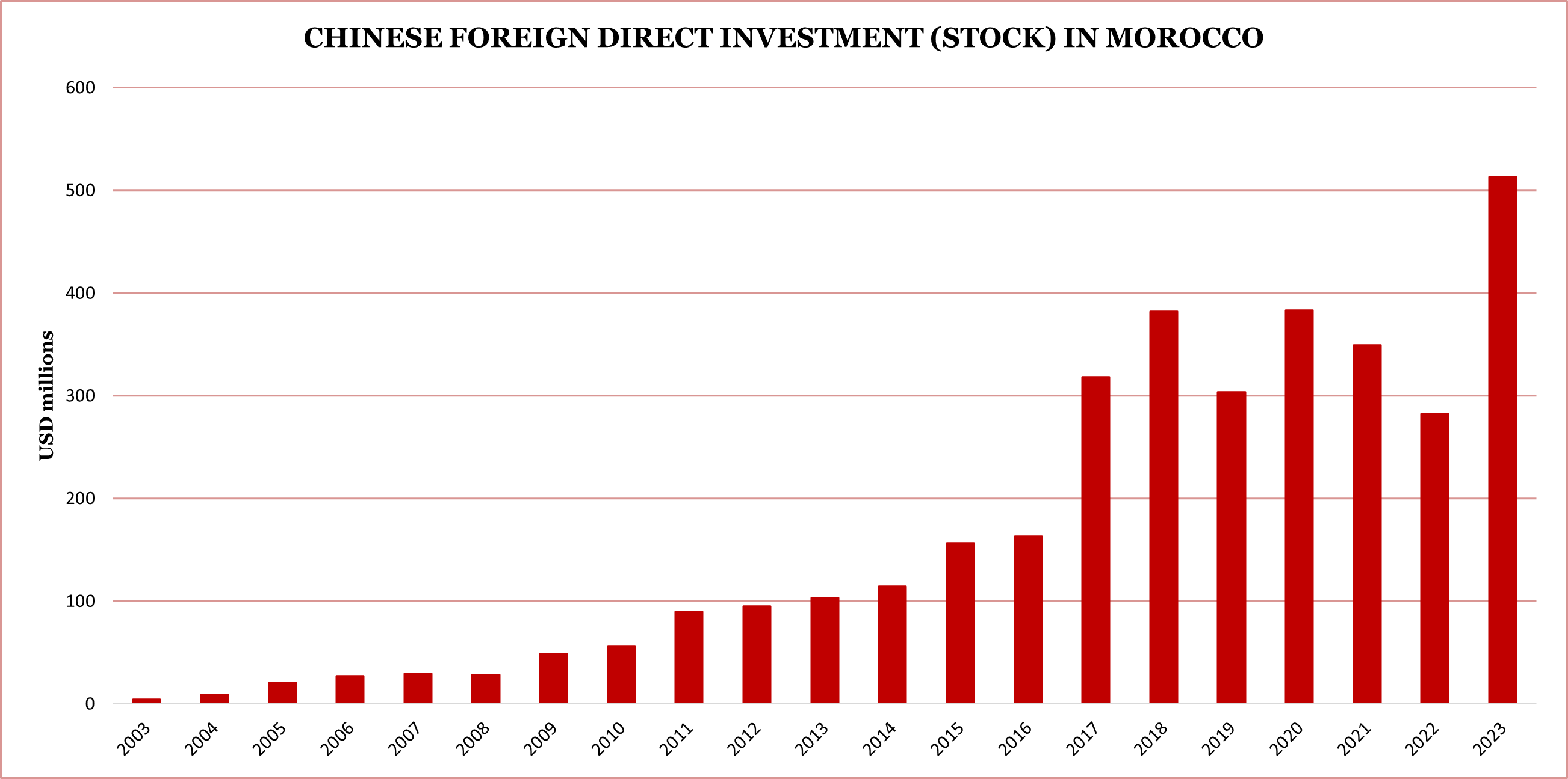
In recent years, public debate and expert analysis on Sino-Moroccan relations have largely focused on economic aspects, including investment, trade, and infrastructure development. A clear milestone in this relationship’s development was King Mohammed VI’s state visit to China in 2016, during which Rabat and Beijing elevated their cooperation to a strategic partnership. The following year, Morocco became the first African country to join China’s Belt and Road Initiative (BRI). The latest figures available on ChinaMed Data reveal that the stock of Chinese foreign direct investment in Morocco has tripled between 2016 and 2023, surpassing USD 500 million.
According to L’Opinion, the official newspaper of the conservative and monarchist Istiqlal Party, Rabat’s strategic position in the global EV battery ecosystem makes it an extremely attractive market destination for Chinese battery manufacturers.[5] Dr. Rachid Yazami, the Moroccan scientist who invented the graphite anode for lithium batteries, echoed this assessment, noting Morocco’s potential to establish itself as a global player in the industry.[6] Phosphate in particular, of which Morocco holds more than 70% of global reserves, represents a key component in the production of lithium-iron-phosphate batteries, which are increasingly sought after due to their safety features and extended life span.
Over time, the Moroccan media debate on Sino-Moroccan economic cooperation has broadened to include political and diplomatic dimensions. This discourse shift became evident after Chinese President Xi Jinping’s unexpected stopover in Casablanca in November 2024. Both Moroccan and international observers interpreted the unofficial visit as a political rapprochement, highlighting Beijing’s role in Rabat’s foreign policy diversification strategy.
Speculation intensified after the Spanish media outlet Espiral 21 reported, citing Chinese sources, that Beijing was allegedly preparing to open a consulate general in Laayoune, the largest city in the Western Sahara, and invest in a land bridge connecting the disputed territory to the Canary Islands.[7] Although neither Beijing nor Rabat confirmed the claims, Jawad Kerdoudi, President of the Moroccan Institute of International Relations (IMRI), affirmed that “there is no smoke without fire” during an interview on Atlantic Radio, an apolitical Moroccan broadcaster covering economic and financial topics.[8]
This debate became only more prominent after Minister of Foreign Affairs Nasser Bourita’s meeting with Wang Yi in Beijing on September 19, 2025. During this two-day visit, the ministers signed a Memorandum of Understanding establishing a Strategic Dialogue mechanism between Morocco’s Ministry of Foreign Affairs and its Chinese counterpart. The framework aims to institutionalize political consultation and strengthen coordination on bilateral, regional, and global issues.
While a few articles in Moroccan media on the visit discussed Chinese investments, most reporting focused on the potential prospect of securing China’s support for the recognition of Moroccan sovereignty over the Western Sahara.
Ya Bilady, an independent online newspaper, observed that even though Morocco’s official communiqué did not explicitly mention the Western Sahara issue, Bourita and Wang’s discussion of “regional and international issues of common interest” (emphasis added) may suggest a convergence on matters such as respect for national sovereignty, territorial integrity, and the fight against separatism and extremism.[9]
Similarly, Abdelnabi Sabri, Professor of International Relations at Mohammed V University in Rabat, noted that deepening Sino-Moroccan ties may hold “significant surprises for the Moroccan Sahara issue,” as the UN Security Council was preparing for its October 31 vote on the matter.[10]
Moroccan experts’ interpretation of deepening Sino-Moroccan ties can be explained by the growing international recognition of Rabat’s sovereignty over the Western Sahara – now officially endorsed by France, the United Kingdom and the U.S. Assured of their support within the Security Council, Moroccan media was hoping that Beijing, alongside Moscow, would maintain a moderate stance by refraining from exercising its veto power.
As mentioned earlier, Beijing has historically had a cautious approach on the Western Sahara, refraining from explicitly taking sides between Rabat and Algiers/Polisario Front, consistently declining to recognize either claim for decades.[11] However, expanding Sino-Moroccan economic cooperation and political dialogue have led Moroccan observers to suggest that China may be reassessing its traditional stance, with several analysts interpreting Beijing’s October 31 abstention on Resolution 2797 as a pragmatic shift, if not an outright diplomatic win for Rabat.
Hicham Ismaili, Ph.D. student at the University of Fes’ Laboratory of Political Studies and Public Law, observed that although “ideological consistency and relationships with other African nations may prevent a full-throated endorsement,” China’s vote can be considered a “tacit acceptance” of the plan.[12]
Similarly, the Moroccan online media outlet Hespress reported the findings of Observatorio de la Política China, a foreign policy research group of the Spanish cultural institution Casa Asia, stating that:
“Although China’s principles have clearly favored a solution through self-determination, in practice, its actions have become more ambiguous and pragmatic over time.”[13]
In a report for the Moroccan think tank Policy Center for the New South (PCNS), Fadoua Ammari, a Lecturer in International Relations at Hassan II University in Casablanca, and Rida Lyammouri, a Senior Researcher at the PCNS,[14] argued that China is “gradually moving toward a convergence of strategic interests regarding the Moroccan Sahara.”[15] They highlight the exclusion of the Sahrawi Arab Democratic Republic (a partially recognized state proclaimed by the Polisario Front), from the 2024 Forum on China-Africa Cooperation (FOCAC), despite its status as a full member of the African Union, as evidence of Beijing’s “implicit refusal to recognize the Polisario Front as the legitimate representative of the Sahara.”[16]
While Ammari and Lyammouri interpret China’s earlier support for Security Council Resolution 2440 (2018) and Resolution 2602 (2021), both considered highly “favorable” to Morocco’s Autonomy Plan, as Beijing attempting to align with the prevailing consensus within the Security Council, they regard the People’s Republic’s most recent posture as instead the result of geoeconomic considerations and the consolidation of Sino-Moroccan ties on the ground. “Morocco is a key partner for its strategy in Africa and the Western Mediterranean,” the report notes, pointing to flagship projects, such as the Gotion High-Tech gigafactory in Kenitra and the active presence of Chinese companies in the Tanger Med port, as evidence.[17] As such, Ammari and Lyammouri maintain that China, to secure regional stability and the security of its investments, should support Rabat’s integration of the Western Sahara.
“A pacified Sahara, well integrated into Morocco, could instead become a space of opportunity: exploitation of mineral resources (the Sahara holds reserves of phosphates, of which Morocco is the world’s leading exporter), development of renewable energies (wind and solar power in the desert), and infrastructure projects linking Morocco to the rest of Africa (trans-Saharan highways, energy links, and a future gas pipeline).”[18]
In a similar vein, Lahoucine Bekkar Sbaai, a Moroccan lawyer specializing in migration, human rights, and the Sahara conflict, holds that Morocco’s accession to the BRI, its role as a reliable investment and trade partner, and its expanding economic cooperation with Beijing are all indicators that “suggest a possible shift in China’s position on the Western Sahara issue, moving towards support for the autonomy initiative and recognition of Morocco’s sovereignty over its Sahara.”[19] This leads him to remark, with notable confidence, that:
“Yes, ladies and gentlemen, if this trend continues on its current trajectory, China’s recognition of Morocco’s sovereignty over the Sahara may only be a matter of time.”[20]
It is noteworthy that, alongside this economic dimension, Bekkar Sbaai also links Beijing’s apparent shift on the Western Sahara to how Rabat “consistently supports China’s territorial integrity in international forums,” particularly on “sensitive issues such as Hong Kong and Taiwan.”[21] A similar observation is also made by Ammari and Lyammouri, who posit that:
“[China’s] conciliatory attitude towards the Moroccan proposal may be part of a broader balancing act: Morocco has supported the “One China” policy (regarding Taiwan) and Beijing’s priorities in international forums, and, in return, China is demonstrating an understanding of Morocco’s sovereignty concerns.”[22]
That said, these optimistic interpretations of Beijing’s position are not shared by all Moroccan commentators. For instance, Souad Mekkaoui, co-founder of the pro-government magazine Maroc Diplomatique, criticizes China’s abstention by comparing its cautious stance against what she defines a “clear-sighted choice” by major Western powers – Spain, France, the UK, the U.S., and Germany. While she previously criticized both Russia and China for their ambiguous positions,[23] Russia’s recent more direct support for Morocco has led Mekkaoui to redirect her criticism primarily toward China.[24]
Confident in Rabat’s global standing, Mekkaoui contends that China must clearly side with Morocco on the Sahara issue: “Beijing can no longer remain hidden behind the curtains of strategic caution […] China must choose […] to decide whether it wants to belong to the camp of History… or to the camp of those who watch it pass by.” To make her point, she also draws a parallel between the Sahara and Taiwan, suggesting that a lack of Chinese clarity on the former would be a “double standard”:
“Beijing, so quick to reiterate its commitment to the principle of territorial integrity, rightly demands that no one challenge its sovereignty over Hong Kong, Tibet, or Taiwan. But how, in the same breath, could it deny Morocco what it claims for itself? […] Morocco has never resorted to interference, never contested the sovereignty of another state, not even that of China. It has always chosen the path of respect, steadfastness, and loyalty. But respect, in relations between nations, is never unilateral; today, it demands reciprocity.”[25]
Noting how “the Sino-Moroccan axis is already strategic and fruitful” economically and that Morocco has become the essential African link for the BRI, she argues that China’s historic partnership with Algeria should not be an obstacle:
“Between the inertia of a bygone ally and the vitality of a partner for the future, the choice should not be difficult. For diplomacy, ultimately, is not measured by rigid loyalties, but by the capacity to embrace the future. […] In this awakening Africa, Morocco stands out as a beacon: stable, bold, and visionary. Therefore, if China truly wants to engage with the Global South, it must recognize this beacon, not bypass it.”[26]
For international observers, however, Beijing’s balanced stance was unsurprising. Jonathan Fulton, Associate professor of Political Science at Zayed University, pointed out in his China-MENA Newsletter that despite China’s comprehensive strategic partnership with Algeria and growing economic ties with Morocco, Beijing’s reluctance to “tip the scales” in disputes such as the Western Sahara reflects its limited ambitions beyond commercial engagement in the Middle East and North Africa.[27]
As Sino-Moroccan economic cooperation has deepened, the Moroccan expert debate has increasingly turned to the potential of greater political convergence between Beijing and Rabat on the Western Sahara issue. As a result, Moroccan media coverage of Bourita’s visit to Beijing moved beyond discussions of Morocco’s growing strategic importance for Chinese economic expansion in Africa, focusing instead on the possibility that China might eventually follow much of the Western world in recognizing Moroccan sovereignty over the Western Sahara.
China’s abstention in the UN Security Council vote on the resolution endorsing Rabat’s Autonomy Plan was widely interpreted as confirming this perspective. Many Moroccan commentators (though not all) presented Beijing’s decision not to oppose the resolution as a positive step, potentially signalling incremental progress toward eventual full recognition. Though some analysts maintain that China should do more, discarding its ambiguous position on the issue and historic partnership with Algeria, a broad consensus has emerged among Moroccan analysts that “realism,” a clear assessment of mutual interests, and perceived parallels with Taiwan could encourage Chinese foreign policy to move beyond its traditionally noncommittal stance and toward endorsing Morocco’s proposed solution to the Western Sahara issue.
Imane EZZEHOUANY is a Research Fellow at the ChinaMed Project. She is also a Ph.D. candidate in History, Cultural Heritage, and International Studies at the University of Cagliari. She holds a Master’s degree in Diplomatic Studies from the Mohammed V University of Rabat and a second Master’s degree in International Relations from the University of Cagliari, where she was subsequently involved in various academic projects as a researcher. Her research focuses on the implications of China’s Belt and Road Initiative for North Africa.
[1] DW, “Western Sahara: Polisario Front leader arrives in Algeria,” June 3, 2021, https://www.dw.com/en/western-sahara-polisario-front-leader-arrives-in-algeria/a-57764852.
[2] Xinhua, “Zhōngguó dàibiǎo duì ānlǐhuì xī sǎhālā wèntí juéyì bù pínghéng biǎoshì yíhàn” 中国代表对安理会西撒哈拉问题决议不平衡表示遗憾 [China’s envoy to UN Council expresses regret over imbalance of Western Sahara resolution], November 1, 2025, http://www.xinhuanet.com/20251101/d2c5ce6481e5426fb7343f50f5234fa5/c.html.
[3] 2MTV, “حوار حصري مع ناصر بوريطة، وزير الشؤون الخارجية والتعاون الأفريقي والمغاربة المقيمين بالخارج” [Exclusive interview with Nasser Bourita, Minister of Foreign Affairs & African Cooperation and Moroccans Abroad], Youtube, November 1, 2025, https://www.youtube.com/watch?v=gWD3Y1V4KDo.
[4] Elmehdi El Azhary, “Sahara : Pékin et Moscou — une convergence pragmatique ?” [Sahara: Beijing and Moscow — a pragmatic convergence?], TelQuel, July 23, 2025, https://telquel.ma/2025/07/23/sahara-beijing-and-moscow-a-pragmatic-convergence_1938969.
[5] L’Opinion, “Batteries pour véhicules électriques: BTR New Material s’apprête à investir 4,9 milliards de dirhams dans une nouvelle usine au Maroc” [Batteries for Electric Vehicles: BTR New Material Prepares to Invest 4.9 billion Dirhams in a New Factory in Morocco], April 25, 2024, https://www.lopinion.ma/Batteries-pour-vehicules-electriques-BTR-New-Material-s-apprete-a-investir-49-milliards-de-dirhams-dans-une-nouvelle_a48324.html.
[6] Hiba Chaker, “La trajectoire inspirante de Rachid Yazami” [The inspiring journey of Rachid Yazami], Maroc Hebdo, July 14, 2023, https://www.maroc-hebdo.com/article/trajectoire-rachid-yazami.
[7] Espiral 21, “China ofrece un puente con Canarias entre España y Marruecos” [China offers a bridge with the Canary Islands between Spain and Morocco], November 13, 2024, https://espiral21.com/china-ofrece-un-puente-con-canarias-entre-espana-y-marruecos/.
[8] Atlantic Radio, “Sahara : vers une reconnaissance de la Chine ?” [Sahara: Towards Chinese recognition?], November 20, 2024, https://atlanticradio.ma/podcast/sahara-vers-une-reconnaissance-de-la-chine.
[9] Mohammed Jaabouk, Sahara: China reassures Morocco ahead of October UN deadline, Yabiladi, September 20, 2025, https://en.yabiladi.com/articles/details/176879/sahara-china-reassures-morocco-ahead.html.
[10] Khadija Alimousa, “بوريطة يزور الصين لتعزيز التعاون.. صبري: محطة أساسية لإنهاء النزاع المفتعل حول الصحراء” [Bourita visits China to strengthen cooperation… Sabri: a key stage to end the contrived Western Sahara dispute], TelQuel, September 18, 2025, https://ar.telquel.ma/بوريطة-يزور-الصين-لتعزيز-التعاون-مع-ب/.
[11] Jamal Laadam, “The Chinese stance on the Moroccan Sahara shifts from neutrality to subtle backing of sovereignty”, Modern Diplomacy, July 18, 2025, https://moderndiplomacy.eu/2025/07/18/the-chinese-stance-on-the-moroccan-sahara-shifts-from-neutrality-to-subtle-backing-of-sovereignty/.
[12] Hicham Ismaili, “China’s Delicate Balance: Predicting Beijing’s Position on Morocco’s Autonomy Plan at UNSC” Morocco World News, October 30, 2025, https://www.moroccoworldnews.com/2025/10/265914/chinas-delicate-balance-predicting-beijings-position-on-moroccos-autonomy-plan-at-unsc/.
[13] Tawfiq Boufertih, “مرصد السياسة الصينية : بكين تميل إلى الحكم الذاتي في الصحراء المغربية” [Chinese Policy Observatory: Beijing tends toward autonomy in the Moroccan Sahara], Hespress, November 7, 2025, https://www.hespress.com/مرصد-السياسة-الصينية-بكين-تميل-إلى-الح-1650995.html.
[14] The PCNS is affiliated with the OCP Group, a state-owned company controlling the biggest phosphate mines in Morocco and the Western Sahara.
[15] Fadoua Ammari & Rida Lyammouri, “La Chine et la Russie face à la question du Sahara marocain : vers une convergence des intérêts stratégiques” [China and Russia on the issue of the Moroccan Sahara: towards a convergence of strategic interests], Policy Center for the New South, June 13, 2025, https://www.policycenter.ma/publications/la-chine-et-la-russie-face-la-question-du-sahara-marocain-vers-une-convergence-des.
[16] Ibid, p. 8.
[17] Ibid, p. 11.
[18] Ibid.
[19] Lahoucine Bekkar Sbaai, “Le Maroc et la Chine : la diplomatie économique au service de la souveraineté sur le Sahara” [Morocco and China: Economic diplomacy in service of sovereignty over the Sahara], Atalayar, November 5, 2025, https://www.atalayar.com/fr/opinion/lahoucine-bekkar-sbaai/maroc-et-chine-diplomatie-economique-au-service-souverainete-sur-sahara/20250609110500215700.html.
[20] Ibid.
[21] Ibid.
[22] See note 15, Fadoua Ammari & Rida Lyammouri, Policy Center for the New South, p.5.
[23] Souad Mekkaoui, “Sahara marocain : Chine et Russie, il est temps de choisir le camp de la légitimité” [Moroccan Sahara: China and Russia, it is time to choose the camp of legitimacy], Maroc Diplomatique, June 6, 2025, https://maroc-diplomatique.net/sahara-marocain-chine-et-russie-il-est-temps-de-choisir-le-camp-de-la-legitimite/.
[24] Souad Mekkaoui, “Sahara : La Russie a choisi, à quand le courage de la Chine ?” [Sahara: Russia has made its choice, when will China show the courage?], Maroc Diplomatique, October 19, 2025, https://maroc-diplomatique.net/sahara-la-russie-a-choisi-a-quand-le-courage-de-la-chine/.
[25] Ibid.
[26] Ibid.
[27] Jonathan Fulton, “China-Iran: more sodium perchlorate deliveries, more discounts for oil. China-Western Sahara: more fence-sitting,” The China-MENA Newsletter [Substack], November 1, 2025, https://chinamenanewsletter.substack.com/p/china-iran-more-sodium-perchlorate.


