PROMOTED by


The ChinaMed Project is continuing its research direction dedicated to documenting and analyzing the stakeholders that shape Mediterranean countries’ China policies (for more information on the methodology, see here). In other words, analyzing the institutional and extra-institutional actors that shape a country’s engagement with China,including how they perceive China, and how much influence they wield. Across the Mediterranean, this encompasses a wide range of stakeholders, from foreign ministries and chambers of commerce to armed militias and Chinese diaspora communities.
While data collection is still ongoing, we are happy to present an early snapshot of our findings through a case study authored by Theo Nencini, one of the minds behind this framework. In this article, he analyses how the impact that the U.S.-Israeli war on Iranian has had on the main actors involved in Iran’s oil trade with China and how they have adapted to the conflict.
---
When the United States and Israel launched their war against Iran on February 28, 2026, they framed it as a struggle over the country’s political system. In a video address that morning, President Donald Trump told Iranians, “when we are finished, take over your government,” as if regime change were the explicit objective. Within days, Tehran closed the Strait of Hormuz. Seven months on, the war has not toppled the regime, but the stakes have changed. The question is no longer whether Iran’s political order will survive, but who will control the conditions under which Persian Gulf’s oil can reach the global market.
Negotiations over the Strait now dominate the conflict. The fourteen-point Islamabad Memorandum of Understanding (MoU), signed on June 17, covers a far broader agenda: a cessation of hostilities, sanctions relief for Iranian crude exports and the banking, insurance and transport services attached to them, the release of frozen assets, a $300 billion reconstruction plan and, eventually, the nuclear file. Yet as the military campaign stalled, these issues receded behind the immediate problem of freedom of navigation. Iranian and Omani negotiators, alongside Pakistani mediation, Qatari proposals and indirect U.S. participation, have spent weeks on a transit arrangement, which Tehran makes conditional on further concessions, including compensation for wartime damage.
Only weeks earlier, the trajectory had appeared different. On June 22, five days after the MoU, the Office of Foreign Assets Control (OFAC), the U.S. Treasury’s sanctions authority, issued General License X, the first broad authorization of transactions in Iranian crude since the 1970s. Covering production, shipping, insurance and dollar payments, it briefly restored a legal framework for Iranian oil exports. It lasted fifteen days. On July 7, after Islamic Revolutionary Guard Corps (IRGC) attacks on commercial vessels in the Strait, OFAC revoked it. American strikes resumed, and the naval blockade of Iranian ports was reimposed on July 14.
The episode exposed the structure beneath the trade. Iranian crude reaches the market through two systems governed by institutions with different interests and capacities. The formal channel, operated by the Ministry of Petroleum and the National Iranian Oil Company (NIOC), holds the statutory monopoly and would gain most from relief, since it depends on legal access to shipping, insurance, banking and counterparties. The parallel channel, operated by the IRGC, thrives precisely where those conditions are lacking. Both deliver into the same market, through intermediaries, transshipment and trading companies that change faster than enforcement can follow.
That market is China, whose regulatory conditions constrain both systems. The Middle East supplied 57% of China’s seaborne crude imports in 2025, and most crude leaving Hormuz goes to Asia, with China by far the largest single buyer. The closure hit hard: June crude imports fell 41.3% year on year to a decade low, and refinery throughput dropped to its weakest level since 2021. Beijing has called for normal transit to resume, Chinese Foreign Minister Wang Yi raising the matter with his Iranian counterpart Abbas Araghchi repeatedly.
China nonetheless remained the destination for virtually all Iranian seaborne crude. Kpler data record it as taking 96.2% of Iranian loadings in 2024, 99.8% in 2025, and the entirety from May 2026 onwards.1 What changed was the volume. The blockade of Iranian ports cut loadings to 271,000 b/d in May 2026, the lowest since June 2020, against a 2025 average of 1.68 million b/d; in July they recovered to about 1.32 million b/d, a fifth below the pre-war level, before the reimposed blockade brought them to zero in September. The war altered how much oil Iran could export, not who bought it.
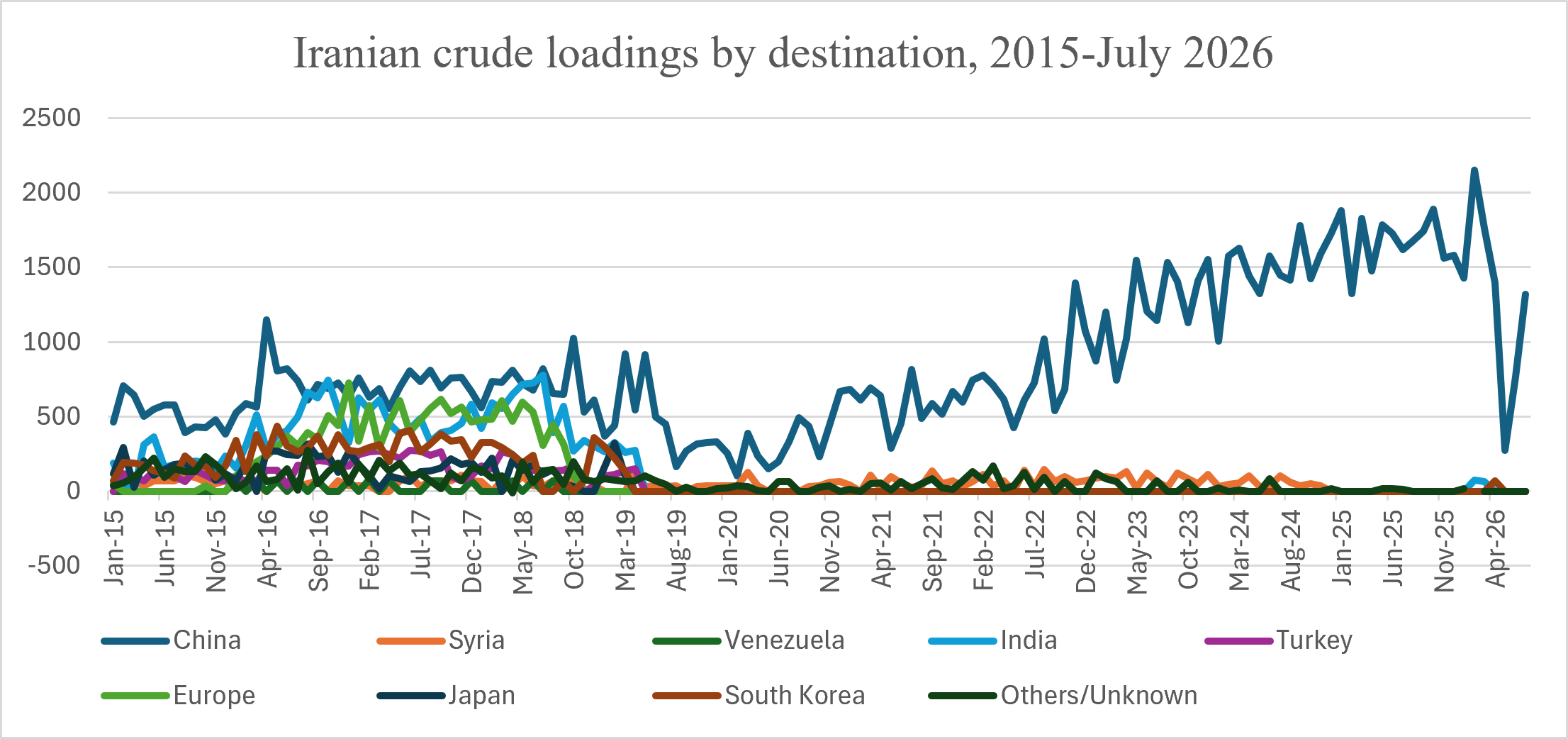
The continuity conceals a redistribution of control. American sanctions on Iranian oil have been enforced without interruption since 1995-96,2 European ones from 2012 to 2016 and again since the September 2025 snapback. Their pressure has weakened the Iranian institutions that relied on conventional commercial infrastructure and favored an apparatus able to operate through opaque networks and to shape, by coercion, the environment in which oil moves. The path that led to the war, and the war itself, did not alter Iran’s dependence on China, which sanctions had already entrenched. They may instead have further transformed who, inside Iran, is best positioned to govern it.
This article applies ChinaMed’s China Policy Stakeholder Mapping methodology to analyze this shift.3 It examines two Iranian stakeholders – the Ministry of Petroleum and NIOC, which retain statutory authority but are losing operational control, and the IRGC, whose sanctions-adapted export system has progressively gained ground on the formal channel – against the Chinese regulatory conditions that determine whether either can keep supplying the Chinese market. The question is not why Iran depends on China, but who, within the Iranian system, increasingly sets the terms on which that dependence yields revenue.
On paper, the Ministry of Petroleum and NIOC remain the sovereign authorities over Iran’s oil sector. In practice, they no longer govern the conditions under which Iranian crude reaches its buyers. The institutions that formally own the oil do not control the networks through which it is sold, transported and paid for. That gap defines NIOC’s position in the relationship with China.
NIOC’s authority predates the Islamic Republic. The 1974 Petroleum Act entrusted the exercise of national sovereignty over Iran’s petroleum resources exclusively to the company. After the 1979 revolution, a Ministry of Petroleum was created to oversee the sector, and the 1987 Petroleum Act assigned it that sovereignty. But the transfer remained largely formal: for decades, NIOC kept most of its prerogatives.
That ambiguity was resolved in 2011-2012, to the advantage of the IRGC. The Guard’s engineering conglomerate, the Khatam al-Anbiya Construction Headquarters, which grew out of its wartime corps of engineers and was granted a near-monopoly over reconstruction after the Iran-Iraq War (1980-1988), entered the oil and gas sector in the mid-2000s. From 2006, the Ministry awarded it South Pars contracts, some without tender, and sanctions accelerated the trend as foreign partners withdrew: in 2010, phases previously contracted to Shell and Repsol went to an IRGC-led consortium. By May 2012, Khatam al-Anbiya held 51 upstream and downstream contracts.4
But the decisive shift was institutional. In August 2011, Rostam Ghasemi, Khatam al-Anbiya’s former commander, became Minister of Petroleum. The IRGC gained the stewardship of the body supervising NIOC. In May 2012, the Majles adopted the Law on the Duties and Powers of the Ministry of Petroleum, which subordinated NIOC to the Ministry. The Minister would now chair its General Assembly and appoint its Managing Director, who also serves as Deputy Minister.5 It also lets the Ministry award contracts without tender and advance funds to domestic contractors, Khatam al-Anbiya first among them. NIOC thus lost its autonomy not to the state in the abstract, but to a Ministry then headed by a former IRGC commander. Ghasemi left office in 2013, but the law remains in force, and his successor, Bijan Zanganeh, undertook efforts to accommodate IRGC-linked firms.
Exports followed a different course. Iranian contractors could replace foreign companies in upstream projects; but no Iranian firm could replace the foreign shipowners, insurers, banks and traders needed to export crude. NIOC sold through Naftiran Intertrade Company (NICO), its overseas trading arm, whose affiliates and front companies in Switzerland, Hong Kong, Malaysia and the Emirates preserved that access. The U.S. Treasury identified four of them in 2012. Each subsequent round of sanctions made that access costlier, and by 2018 the erosion that had already reached NIOC’s upstream extended to its exports.
After the American withdrawal from the JCPOA, Executive Order 13846 restored, from November 2018, the exposure of non-U.S. persons to secondary sanctions for supporting NIOC and NICO. NIOC’s designation under Executive Order 13224 in October 2020, alongside the Ministry and the National Iranian Tanker Company (NITC), placed the formal channel under counterterrorism authority. From then on, NIOC had to sell in the same clandestine environment as the IRGC, partly through the Guard’s own structures. According to Reuters, NITC now transfers crude at sea onto IRGC-operated vessels bound for China. U.S. Treasury actions now name NIOC and NICO alongside the networks that ship IRGC cargoes. The two channels have become hard for enforcers to separate, but they remain politically distinct.
NIOC’s interest in relief is correspondingly unambiguous. A relaxation of sanctions would lower freight and insurance costs, restore access to finance, reopen an upstream sector starved of capital since the late 2000s and now operating obsolescent infrastructure. It would also realign the company’s legal standing with its operational means. General License X matched these interests very closely.
Within the ChinaMed stakeholder framework, NIOC therefore sits at the periphery of the winning coalition, subordinate to its core – the Supreme Leader and the security establishment, the IRGC foremost. Its indispensability is operational rather than decisional: the leadership relies on the export system NIOC administers, but the core coalition sets the terms on which that system operates. Its position towards China follows: it is in favor of stronger relations, but by necessity, since dependence on Chinese buyers reflects the closure of alternatives, not a preference among them. Toward the United States and the European Union, its position is the mirror image – formally hostile, materially interested in normalization. NIOC implements a Look East orientation that Supreme Leader Ali Khamenei made a foreign policy priority in 2018.
The dependence is thus twofold. On Chinese demand, because sanctions narrowed NIOC’s customer base; and on decisions taken elsewhere in Tehran for the conditions of reaching it. The Islamabad Memorandum’s economic provisions would benefit the formal channel most, yet none of the obstacles to their implementation lie within its control. Authority over Hormuz rests with an institution whose own export networks would gain little from relief.
The IRGC occupies the opposite position. It has no statutory role in the oil industry, yet it increasingly controls the infrastructure through which a substantial share of Iranian crude reaches the market. Its power lies in its ability to operate where legal ownership has become hard to exercise.
This role predates the 2026 war. Over the past decade, and especially since U.S. withdrawal from the JCPOA in 2018, the IRGC has built an export architecture spanning oil allocation, trading companies, logistics, shipping and financial intermediaries. At its center is the Shahid Purja’fari Oil Headquarters,6 set up, according to Reuters, by Qasem Soleimani and initially run by Rostam Ghasemi. OFAC’s designation of three of its officials on May 11, 2026 named it for the first time in a U.S. enforcement action. Sources cited by Reuters in December 2024 estimated that the Guard controlled up to half of Iran’s oil exports, against a fifth three years earlier.
The difference from NIOC is one of organizational logic. NIOC was built as a conventional state oil company and adapted to sanctions later. The IRGC’s system was built for sanctions, in stages. Around 2013, the government began paying the Guard and its Qods Force partly in crude, which they had to market themselves. After the 2018 sanctions reimposition, Qods Force networks – one of them overseen, according to OFAC, by Ghasemi – moved crude to buyers in China, Russia and Syria through intermediaries that concealed its origin. From 2020, Shahid Purja’fari turned these practices into a systematic commercial architecture.
Sanctions thus shape the IRGC’s activity more than they constrain it. They do carry a cost: buyers demand a discount for the added legal and reputational risk, estimated at $1-2 to around $5 a barrel, sometimes $8 – but the cost doubles as a competitive edge, since buyers willing to absorb the risk receive cheaper oil.
The entire model depends on opacity. Vessel ownership is obscured, transponders are disabled or manipulated, cargoes are transferred at sea, and front companies in the Emirates, Turkey, Hong Kong and mainland China interpose layers between seller and buyer. U.S. enforcement has repeatedly targeted these networks. Yet opacity is an organizational asset rather than just a necessary evasion technique. NIOC must identify its counterparties in order to insure, finance and enforce its contracts. The IRGC distributes those functions across a network in which no single intermediary carries the whole transaction, and in which designated entities are replaced faster than they can be identified. Sanctions have therefore produced churn. Opacity also resists measurement: the “up to half” figure is an estimate; the exact share of oil exports moving through the Guard’s channel remains unknown.
Chinese demand is central to this resilience. Crude allocated in lieu of cash must be sold, and the allocation has become a major budget item: the 2025-26 budget bill gave the armed forces 47% of the oil export revenue allotted to the general budget, against 43% for the government. Selling crude is thus a condition of the Guard’s own financing. China’s independent refiners – above all the Shandong teapots, whose thin margins make discounted feedstock worth the legal risk – provide the demand on which this financing rests. NIOC and the IRGC thus reach the same market for different reasons: NIOC because its other customers have left, the IRGC because its funding depends on buyers who tolerate opacity. They also compete for it: by the lower estimate, the Guard sells $1-2 a barrel below NICO, and a trading source told Reuters that export revenue is split roughly evenly between the two.
Within the ChinaMed framework, the IRGC’s position inverts NIOC’s at every point. It belongs to the core of the winning coalition, combining coercion, economic resources and direct access to the Supreme Leader – access the war has strengthened, Mojtaba Khamenei appearing increasingly dependent on the organization that forced through his accession. Its interest is primarily security-related and secondarily economic, oil revenue funding its operations. It is in favor of stronger relations with China, but by design: its position derives from a funding model that presupposes a sustained Chinese demand. It shapes both the goals and the implementation of policy, and can act alone, its coercive capacity shaping the environment in which oil moves, while its commercial network sells with considerable autonomy from the petroleum bureaucracy. For such an actor, the framework’s line between formulating and implementing policy is difficult to sustain.
Hormuz makes this overlap consequential. The Persian Gulf Strait Authority, established on May 5, 2026 and designated by OFAC on May 27 as an IRGC-linked mechanism for regulating and monetizing maritime traffic, made Iranian permits a condition of passage and turned access to the Strait into leverage. The Guard’s conduct there does not appear aimed at keeping the China trade clandestine: its purposes seem to be bargaining power and regime security, with opacity as a by-product. The attacks on commercial vessels that preceded the revocation of General License X on July 7 fit this reading. They followed repeated U.S.-escorted transits through the Omani channel, despite an Iran-Oman arrangement routing traffic through Iranian waters, and read best as a signal to Washington during ongoing negotiations. Their effects were nonetheless twofold: they removed the prospect of a revived formal channel, where the IRGC’s advantage is weakest, and brought back the blockade, after which no Iranian crude cargo reached China through the Strait. Whether the first effect was sought cannot be established; the second suggests that Chinese demand, however vital, weighs little in the Guard’s security choices.
The IRGC has not replaced NIOC, and the two systems remain intertwined: the cargoes it sells originate in fields NIOC operates and leave from terminals it administers. What separates them is organizational advantage. As formal channels lose effectiveness, the premium goes to whoever can absorb legal risk, conceal counterparties and keep cargoes moving. Under sanctions, sovereignty over oil belongs to whoever can make it move.
The balance between the two channels also shapes the nature of Iran’s relationship with China. Through NIOC, oil becomes part of an opaque but still state-to-state exchange. According to sources cited by Reuters, a buyer working for the Chinese state-owned trader Zhuhai Zhenrong paid for crude bought from a NIOC-linked company into a China-based entity, ChuXin, which directs around 70% of the proceeds to Chinese companies building infrastructure in Iran. It sends the remainder to a vehicle operated by entities acting for China’s Ministry of Commerce and Iran’s central bank, which uses the funds to pay for imports approved by the central bank. The IRGC’s channel works differently. It turns oil into revenue that the Guard distributes itself, reducing China to a market. As the IRGC’s share increases, more of China’s payments bypass the Iranian state’s own allocation mechanisms. The actor closest to the core of the coalition, moreover, has the least to gain from a normalization that would let Iran diversify its customers. The IRGC’s growing influence therefore tends to deepen Iran’s dependence on China, even though Chinese interests appear to place few constraints on it, as Hormuz suggests. In its energy dimension, Iran’s China policy appears less a strategy towards Beijing than the result of how control is distributed within Iran.
Neither system operates on terms of its own making. The conditions governing access to the single external market are set in China – by regulation, the structure of its refining sector, and its buyer’s risk tolerance. China thus indirectly sets the parameters within which the competition between NIOC and the IRGC takes place.
Beijing has long opposed secondary sanctions as illegitimate extensions of U.S. jurisdiction, while systematically prioritizing the continuity of its own energy supply. Its interest in Iran is not only commercial: throughout the war, Chinese diplomacy defended Iran’s sovereignty and security, Wang Yi calling it unacceptable to kill the leader of a sovereign country and instigate a change of government. Yet Beijing has no preference between the Iranian sellers. A Chinese state-owned trader, Zhuhai Zhenrong, has reportedly dealt with NIOC’s channel; but independent refiners buy from whoever offers the better terms, the Guard’s intermediaries included. What matters to Beijing is that Iranian oil keeps flowing, not who sells it.
China contains the risk of this trade through the structure of its refining sector. Since the reimposition of U.S. sanctions in 2018, the state-owned majors, exposed to the dollar system, have largely stopped buying Iranian crude, leaving it to independent refiners concentrated in Shandong. This division of labor is a matter of policy. Beijing opened crude imports to the independents only in 2015, and still controls their access through import quotas. In April 2026, it reportedly granted them extra quotas precisely to import the sanctioned crude the majors cannot take. The arrangement secures discounted supply while keeping China’s systemic firms at a distance. The result is a narrow interdependence: Iranian sellers need buyers willing to take sanctioned crude; the teapots need feedstock cheap enough to compensate for legal and logistical risk. No state-to-state transaction is required – traders, front companies and shipowners mediate it.
That arrangement, long sustained by Beijing without acknowledgment, was tested on April 24, 2026, when the U.S. Treasury designated Hengli Petrochemical (Dalian) and some forty shipping companies and vessels linked to Iran’s shadow fleet. Hengli, in Liaoning, is one of China’s largest refining complexes, far above the ordinary teapots in scale. American pressure had reached a much larger segment of China’s refining industry. Beijing responded on May 2, the Ministry of Commerce issuing its first Prohibition Order under the so-called “Blocking Rules” promulgated in January 2021, designed to counter the improper extraterritorial application of foreign laws.7 The Order prohibits Chinese entities from complying with the relevant U.S. measures against five refiners and gives them a right to sue, in Chinese courts, banks and insurers that withdraw on American grounds.
The Order anchors the Shandong channel in Chinese law. Refineries now operate under an explicit prohibition on complying with U.S. secondary sanctions, which raises the cost, for any third-country bank or insurer, of disengaging. It also formalizes a posture that had previously operated through silence. Cui Fan, a professor who has advised the Ministry of Commerce, warned that allowing the American measures to continue would “disrupt the stability of China’s energy supply chain.” But the measure is not framed as a service to Tehran. It asserts that companies operating under Chinese jurisdiction should not comply with restrictions Beijing considers an improper extension of American law, formalizing a principle of sovereignty while protecting a domestic commercial interest.
The limits of the instrument are equally important. Issued twelve days before the Trump-Xi summit of May 14-15, the Blocking Order creates no general exemption from U.S. sanctions, guarantees no access to international banking, shipping or insurance, and protects none of the Iranian networks that bring crude to China. Beijing can make compliance unlawful only under Chinese law. The measure is therefore best understood as “selective formalization”: a previously tolerated trade acquired an explicit domestic legal basis once U.S. enforcement began to hurt significant Chinese companies. It places China on Tehran’s side against secondary sanctions, as Chinese diplomacy had done throughout the war, but within bounds that shield China’s own systemic actors. Beijing wants to show it cannot be coerced, while keeping its major banks and companies clear of exclusion from the international financial system.
A second limit lies in the commercial conditionality of Chinese demand. The blockade sharply reduced Iranian loadings and disrupted a wider Gulf supply system on which most Chinese refiners depend. Beijing, while calling for freedom of navigation, has stayed out of the bargaining over the Strait. When Hormuz reopened in late June, the teapots themselves turned away from Iranian crude. According to traders cited by Reuters, they bought 16 to 20.5 million barrels from Qatar, Iraq and the UAE, partly through Chinese state traders – their largest purchases of non-sanctioned Gulf oil since the war began – at discounts of $5-8 a barrel to Brent, while discount on Iranian Light held at $2-3 and Iranian cargoes accumulated at sea. The buyers on which both Iranian channels depend follow price.
The result is a calibrated engagement with an inherent tension. Beijing has moved from tacit support for Iranian trade to the formal protection of select Chinese buyers, a protection that stops where Chinese jurisdiction does: it covers the Chinese end of the trade, not the Iranian sellers, the shipping companies designated with Hengli, or passage through Hormuz. Beijing seeks the continuity of Iranian supply on acceptable terms, not of the arrangements, clandestine or formal, that currently deliver it – and thus not of the constraints that made the IRGC’s system indispensable.
The mapping shows who governs Iran’s oil relationship with China, and how that has changed. Control has shifted from the institution that owns the oil to the one that can move it. The sector remains formally a state monopoly, but ownership, execution and constraint are now disaggregated. NIOC retains statutory authority, the IRGC controls much of the infrastructure that brings oil to market, and Chinese actors set the trade’s conditions. No single institution governs the relationship in its entirety.
This shift affects the substance of Iran’s China policy, not only its execution. The Look East policy is set at the top of the system, but what it means in the oil sector depends on who sells. Through NIOC, a state-supervised exchange of crude for Chinese construction and goods. Through the IRGC, revenue the Guard allocates to its own priorities. The stakeholder gaining ground has the least interest in the normalization that would loosen Iran’s dependence on China.
The war appears to have consolidated this configuration. The succession has tightened the alignment between coercive power and economic extraction, subordinating revenue generation to regime security. Limited sanctions relief would not, by itself, alter this structure. It would restore some operational capacity to the formal channel without removing the advantages the IRGC accumulated under prolonged constraint, which are now embedded in the organization of the trade. A return to pressure would widen them further. Either way, the balance moves in the same direction: the IRGC prevails because it is structurally adapted to sanctions, opacity and legal risk; NIOC loses ground because it is not.
The Chinese position, meanwhile, has moved from tacit support to selective formalization. It sides with Tehran against secondary sanctions and externally imposed regime change, but protects the Chinese end of the trade rather than Iran’s networks. The Blocking Rules apply an established doctrine once sanctions hurt significant Chinese companies; Iran is their most visible test case. On the Strait, the same defense of its own interests places Beijing beside Washington: the consensus concluding Xi Jinping’s state visit to the United States in September states, in its point on Iran, that “no country or institution can be allowed to impose tolls on international waterways.” Beijing’s calibration appears to track the wider state of U.S.-China relations.
A Chinese decision to close the teapot channel would strike at the IRGC’s system from outside. Beijing’s refining policy points towards consolidation: it has sought to cut the number of independent refiners, capping national refining capacity and ordering the smallest units closed. A rapid closure nonetheless looks unlikely. Iranian crude, one of the cheapest feedstocks on which the teapots rely, made up between half and two-thirds of the intake of Shandong’s small independents in 2024. The teapots are the mainstay of local economies in a province of some 100 million people, whose authorities, reliant on their taxes and jobs, have repeatedly blunted consolidation drives and raised their tax rebates as recently as 2025. During the Hormuz crisis, Beijing itself told them to keep running and granted extra import quotas. At about 13-14% of China’s crude imports,8 Iranian oil is not decisive for China as a whole, but it is for Shandong’s economic balance. Beijing’s short-term priority is to keep these refineries supplied; any reconfiguration of the import system belongs to the longer term.
The system’s Iranian foundations are no less durable. Even if diplomacy were to resolve the nuclear and Hormuz questions and restore sanctions relief, the Purja’fari system would not disappear. Its survival rests on politics rather than commerce. The IRGC fought the war, generated much of the leverage that brought Washington back to the negotiations, shaped Khamenei’s succession, and now stands as the principal pillar of regime cohesion. An organization so placed is unlikely to dismantle the commercial infrastructure that finances its autonomy because legal trade resumes. Relief would revive the formal channel without eliminating the parallel one. The two would coexist.
Nor would normalization rapidly displace the clandestine network. International shipowners, banks and insurers would return cautiously, while the established Chinese channel would continue moving cargoes. China would probably remain the largest single buyer of Iranian crude.
The decisive question, then, is not whether Iran will keep selling oil, but through whom – and the answer defines what its relationship with China consists of. Under any settlement currently conceivable, the Islamic Republic is likely to retain a dual export architecture. What is contested in Tehran is the seller. The customer, for as long as sanctions endure, is not.
Theo NENCINI is a Research Fellow at the ChinaMed Project. He is also a Lecturer in International Relations and a PhD Candidate at Sciences Po Grenoble and the Catholic University of Paris. His research focuses on Iran-China relations, approached from a long-term systemic perspective and through a multilevel analysis, both with regard to Iran’s strategic thinking, political complexity and regional integration dynamics, and China’s foreign policy toward the Middle East.
1) Kpler tanker-tracking data (July 2026): monthly averages of crude loadings by assessed final destination. Loadings are not equivalent to Chinese customs imports, since cargoes are routinely re-declared at transshipment, principally in Malaysian waters.
2) Executive Orders 12957 and 12959 (1995) and the Iran and Libya Sanctions Act (1996).
3) The framework codes each actor along seven dimensions: identification as a principal actor; institutional category; role in the political system; interest; channel of engagement; position towards China, the United States and the European Union; and influence over the formulation and the implementation of policy. It is applied here to two institutions in a single sector.
4) W. Yong, NIOC and the State, Oxford Institute for Energy Studies, 2013, pp. 7-8 and 15-16; A. Alfoneh, Political Succession in the Islamic Republic of Iran, AGSIW, 2019, p. 14.
5) The incumbent, Hamid Bovard, was appointed acting minister on October 4, 2026, when President Pezeshkian accepted the resignation of Minister of Petroleum Mohsen Paknejad, officially for personal reasons.
6) Shahid Purja’fari is distinct from Sepehr Energy Jahan Nama Pars, which OFAC describes as the oil sales arm of the Armed Forces General Staff. Both market crude allocated to the military, the IRGC and the General Staff each receiving its own allotment, and they rely on overlapping intermediaries.
7) Article 12 establishes that “In response to unjustified extra-territorial application of foreign legislation and other measures, the Chinese Government may take necessary counter-measures based on actual circumstances and needs.”
8) Kpler data; author’s calculations: 13.8% (2024), 13.0% (2025).


