PROMOTED by


This document presents the roadmap for implementing the China Policy Stakeholder Mapping framework, walking coders through each dimension step by step. Overall, the methodology is designed to answer one core analytical question: who are the main actors that shape a country's China policy, and through what interests, channels, and mechanisms do they do so?
The application of the framework is twofold: 1) At the country level, the goal is to identify all relevant actors that shape the country's broader relationship with China across all domains, and 2) At the sector/case level, the scope is narrower: to identify actors that shape China policy within a specific policy field, such as infrastructure, energy, technology, etc. The coding categories remain the same in both applications, but the coding should correspond to the analytical focus. For example, stakeholders may receive (some) different coding depending on the level of analysis, which reflects the fact that same actors sometimes pursue different goals and operate through different channels across policy domains.
In all cases, the methodology is designed to produce comparable data across different national contexts. The key is to ensure that local realities are translated into the broader, universal categories the framework provides. To illustrate the logic of each coding step, this guide uses Serbia's engagement with China on infrastructure as a running example throughout.
Stakeholders are individuals, groups, or organizations within a policy field who are affected by policy decisions and therefore have an interest in those decisions (Hassel and Wegrich 2022, 194). Stakeholders are relevant for policy formulation and implementation in many ways. Classical stakeholder analysis treats policy-making as a field structured by actors with differing interests, resources, and degrees of influence (Varvasovszky and Brugha 2000; Hyder et al. 2010). Work on participatory governance likewise stresses that policy outcomes are shaped not only by formal institutions but also by wider constellations of interested and affected actors whose preferences, expertise, and coalitional behavior matter for implementation and legitimacy (Höfer and Madlener 2020). Network and discourse-oriented approaches further show that stakeholders shape policy not only through formal authority, but also through framing, coalition-building, and the circulation of ideas in public debate (Buckton et al. 2019; Puri et al. 2017). Overall, stakeholders matter not simply because they exist in the policy environment, but because they occupy positions from which they can support, mediate, resist, legitimize, or constrain policy.
For the purposes of this framework, we recognize that not every actor affected by China policy is equally relevant for stakeholder mapping. This guide therefore defines stakeholders as actors with a stake in a country’s China policy and with some observable relationship to its formulation and implementation.
This section presents the step-by-step application of the methodology for building a stakeholder map. Each step corresponds to one dimension of the framework and addresses a specific coding decision. The steps are ordered to reflect the natural progression of the coding process: from identifying who the relevant actors are, to locating them in the institutional and political landscape, to assessing their interests, channels, positions, and influence.
The unit of observation in the analysis (and in the dataset) is the stakeholder. Each entry should capture a principal actor: one whose own interests are being pursued, rather than one acting on behalf of someone else. Individual officials, or local officeholders who operate primarily as transmitters of the interests of contractors, subcontractors, or other organized beneficiaries are not expected entries in the dataset.
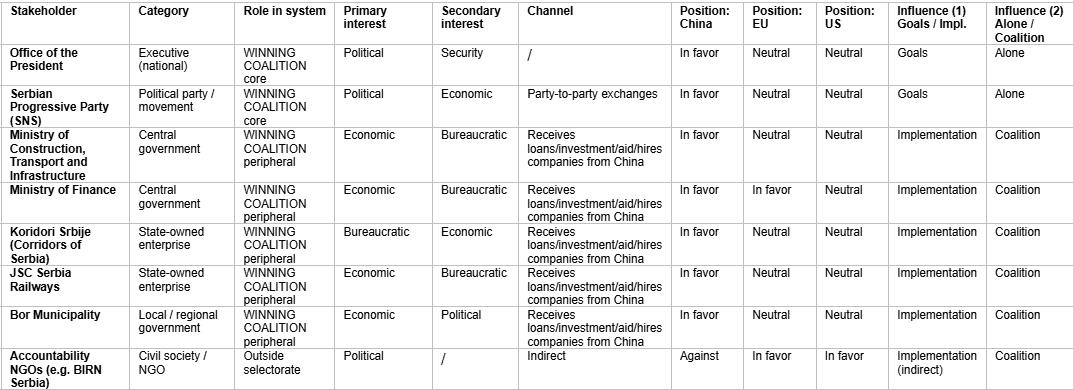
In the Serbian infrastructure case, the Office of the President is coded as a principal because it uses infrastructure cooperation with China to pursue its own political goals: developmental legitimation, control over the strategic direction of major projects, and the presentation of Serbia as capable of attracting large-scale investment from multiple external partners. SNS is included as the main political party that uses Chinese-backed infrastructure projects as part of its own political and electoral narrative. The Ministry of Construction, Transport and Infrastructure is included because it has an identifiable institutional stake in project delivery, sectoral coordination, and the implementation of major transport infrastructure. The Ministry of Finance is included because it pursues its own goals in structuring and managing external financing for infrastructure projects.
On the other hand, individual officials within these institutions are not coded separately, as they act through and on behalf of the institutions listed above rather than as principals in their own right.
The category dimension captures the broader institutional type a stakeholder belongs to, defined independently of China policy. This allows for analytical aggregation across countries: we can have analysis that leads to conclusions such as "China policy in area X in country Y is primarily shaped by executive actors" or "military and security stakeholders are consistently more cautious about China engagement across cases Z and W."
Most coding decisions in this column are straightforward. In the Serbian context, the Office of the President is Executive; the Serbian Progressive Party (or any other party) a Political party or movement; the Ministry of Finance (or any other Ministry) is Central government; BIRN (or any other NGO) is Civil society or NGO.
Occasionally the lines between categories could appear blurred, and coders should think carefully about whether what looks like one actor might in practice be two with distinct interests and behavior (which requires close knowledge of the local context).
This dimension is grounded in selectorate theory (Bueno de Mesquita et al., 2005) and asks how central an actor is to regime survival and elite decision-making in a country's domestic political system. It says nothing directly about China, but allows us to map how China policy is shaped by the domestic distribution of political power.
The framework distinguishes four positions: i) the winning coalition consists of actors whose active support the leadership genuinely needs in order to stay in power. Within it, the core includes those who directly constitute and sustain political power (the actors around whom the regime is organized), ii) The periphery includes actors who are politically important and embedded within the ruling system, but remain subordinate to the core. iii) the selectorate is broader: it encompasses politically relevant actors who are part of the wider field of elite competition and could in principle participate in governing coalitions, even if they are currently excluded from power, and iv) outside the selectorate are actors who do not participate in these elite bargaining structures at all, even if they may still matter in other ways: e.g. through public pressure.
This dimension requires careful knowledge of the local political context, because the same actor may occupy different positions across countries. E.g. ministry that is peripheral in one system may be core in another if it controls resources the leadership depends on. When coding, we should therefore focus not only on formal office but on how power actually operates in practice: who the leadership depends on, which actors are part of the ruling coalition, which are politically relevant but excluded from power, and which remain outside elite decision-making altogether.
The Serbian case illustrates the full range. Power in Serbia is highly centralized, organized around the senior leadership of SNS, aligned national media, the security apparatus, and the leadership of key state-owned enterprises, all of whom are essential to regime continuity. The Office of the President and SNS accordingly belong to the winning coalition core. A step below, actors such as aligned local leaders and business figures working within the regime are institutionally relevant and may shape implementation, but remain subordinate to the core and depend on it for their authority and mandates; a mayor of an SNS-aligned municipality would be coded winning coalition peripheral. Opposition parties such as the SSP are politically relevant, maintain parliamentary presence, and participate in the broader field of elite competition, so they belong to the selectorate, but not the winning coalition. Accountability NGOs such as BIRN, finally, sit outside the selectorate: they lack formal policy access and are not part of the elite negotiation circuits through which power is exercised, even though their investigations may increase public pressure and attention to some issues related to implementation of infrastructure projects.
This dimension captures the underlying goal that best explains why a stakeholder supports, opposes, or seeks to shape ties with China. It should identify the interest that most plausibly explains the actor's behavior: Economic, Security, Religious, Political, and Bureaucratic, so the coding question is always: what goal best explains this actor's position on China in practice?
In the Serbian infrastructure case, e.g. the Office of the President is coded Political. Chinese-financed infrastructure brings material benefits, but promotion of these projects has consistently been embedded in a broader narrative: proof that Serbia can attract major investment, act autonomously between East and West, and deliver visible development under current leadership. Infrastructure here is a political resource, and the economic gains serve the broader political interest.
The secondary interest field should only be used where a second goal materially changes how the actor behaves. Economic is a meaningful secondary interest for SNS, since Chinese-backed infrastructure strengthens the party's electoral messaging.
The channel records how the actor operationally connects to China. In majority of cases it is concrete, and observable in e.g. public documents.
One of the most relevant to the Serbian infrastructure would be receiving loans and investment from China (Ministries or SOE), hiring Chinese companies. The Ministry of Finance's channel would be e.g. the EXIM Bank loan agreement itself (a documented, publicly available).
The hardest channel decision involves accountability NGOs. They have no direct engagement with China and should not be forced into any of the standard channel categories. Their relationship to Serbian China policy is indirect: they investigate it, publish findings, and feed those findings into EU institutional processes. This should be described in 'Other important info'.
This dimension captures each stakeholder's observable orientation toward stronger relations with China, the United States, and the European Union. Position should be inferred from consistent behavior, documented choices, and repeated public statements over time.
In the Serbian infrastructure case, the Office of the President and SNS would be e.g. coded as In favor of stronger relations with China. This reflects not diplomatic language but repeated and active support: acceptance of Chinese contractors in major transport projects, pursuit of Chinese development finance, and sustained public framing of China as a desirable development partner. They promote and defend the cooperation with China. When it comes to European Union, this case could be more tricky. Official rhetoric alone would suggest In favor of stronger relations with the EU. However, in the Serbian case, the gap between pro-EU rhetoric and limited reform progress means that Neutral may be more appropriate (reflecting practical stance towards EU as balancing act, rather than stronger relations per se).
Accountability NGOs in Serbia, e.g. in the infrastructure context are coded Against stronger relations with China where their work consistently focuses on opaque loan terms, procurement exemptions, transparency deficits, or governance risks associated with Chinese-backed projects, while they might be coded as Neutral if we look at the China policy in general.
This dimension captures both the stage at which a stakeholder can influence China policy and the conditions under which that influence operates. The first question is whether the actor shapes policy goals, policy implementation, or neither. Shaping goals means influencing the overall strategic direction of China policy (for example, the decision to pursue Chinese-financed infrastructure as a development model). Shaping implementation means influencing how that policy is carried out in practice: loan negotiations, contractor selection, procurement arrangements, project oversight, and so on. The second question is whether the actor can exercise that influence singlehandedly or only in coalition with others.
In the Serbian infrastructure case, the Office of the President and SNS shape goals: they define and politically sustain the broader strategy of cooperation with China, of which infrastructure is a central component. The Ministry of Construction and the Ministry of Finance primarily shape implementation, influencing how projects are structured, financed, and delivered rather than whether to pursue them. Koridori Srbije operates at the same level, shaping implementation through its role in project execution and contractor management. Accountability NGOs such as BIRN influence implementation indirectly: they do not set policy goals, but through investigative reporting and public scrutiny they raise the political and reputational costs of particular implementation choices, which can constrain how projects are designed or defended.
On the second question, only the Office of the President is coded as able to shape policy singlehandedly in this case. All other actors require some form of coalition or alignment with others for their influence to be effective. SNS is highly influential, but its capacity to sustain a policy direction depends in practice on alignment with the presidential core. The ministries depend on political authorization from above and operational coordination with each other. Even accountability NGOs, whose influence pathway is indirect, require EU institutional allies or domestic media amplification to convert their findings into meaningful policy pressure.
Walking through the coding steps on example for Serbia's infrastructure cooperation with China shows that e.g. China policy in this domain is driven from the core of the winning coalition: the Office of the President and SNS set the strategic direction, while implementation is delegated to ministerial and state-owned enterprise actors whose interests are predominantly economic and bureaucratic, and whose positions are operational rather than ideological. Civil society actors operate outside formal power structures but shape the public space by revealing the governance, environmental, and transparency implications of infrastructure projects.
These preliminary observations are useful for qualitative understanding of the specific case (or to answer specific questions), but their analytical value is greatest in comparative perspective. A single case cannot tell us e.g. whether the concentration of goal-setting power in the executive core is a general feature of China policy across the Western Balkans or a product of Serbia's specific political configuration. Nor can it tell us e.g. whether economic or bureaucratic interests among implementing ministries tend to be more or less stable than political interests across different regime types.
De Mesquita, B. B., Smith, A., Siverson, R. M., & Morrow, J. D. (2005). The logic of political survival. MIT press.
Varvasovszky, Z., & Brugha, R. (2000). A stakeholder analysis. Health policy and planning, 15(3), 338-345., available: https://pubmed.ncbi.nlm.nih.gov/11012410/
Buckton, C. H., Fergie, G., Leifeld, P., & Hilton, S. (2019). A discourse network analysis of UK newspaper coverage of the “sugar tax” debate before and after the announcement of the Soft Drinks Industry Levy. BMC public health, 19(1), 1-14.
Höfer, T., & Madlener, R. (2020). A participatory stakeholder process for evaluating sustainable energy transition scenarios. Energy Policy, 139.
Hyder, A., Syed, S., Puvanachandra, P., Bloom, G., Sundaram, S., Mahmood, S., ... & Peters, D. (2010). Stakeholder analysis for health research: case studies from low-and middle-income countries. Public health, 124(3), 159-166.
Puri, S., Fernandez, S., Puranik, A., Anand, D., Gaidhane, A., Quazi Syed, Z., ... & Thow, A. M. (2017). Policy content and stakeholder network analysis for infant and young child feeding in India. BMC Public Health, 17(2), 39-53.
Nunberg, B., & Abdollahian, M. (2006). Operationalizing Political Analysis for Development: An Agent Based Stakeholder Model for Governance Reform.